
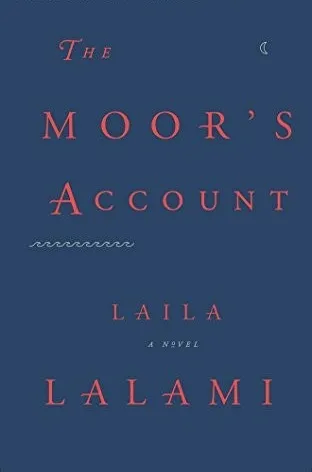
Why this book
Three clocks run at once in the opening pages of this novel. One counts holy time. One counts the years of a man's own body. One counts the years of the men who own him. Laila Lalami sets all three ticking before a single ship leaves harbor, and that is the first thing worth noticing: a man is telling us his life from a room that is not his, on paper he does not own, in a language that was put on him after his own name was taken off. The book is an answer to a book already written — the report Álvar Núñez Cabeza de Vaca published in 1542 about the Narváez expedition, which sailed from Spain in 1527, broke apart on the Florida coast, and shrank, over eight years, to four men walking west into Mexico. Cabeza de Vaca's account survived. Estebanico (also spelled Estevanico) appears inside it as a servant, a pair of hands, a body useful for carrying. Lalami takes that slot in the record and puts a person back inside it: Mustafa ibn Abdullah of Azemmur, Moroccan, Muslim, son, brother, husband, father, a man who began life with a household and a trade and ended it with a borrowed name.
Why does this matter to a life — yours, mine, anyone's? Because almost nothing it describes has stopped. The forms of possession have changed addresses, not habits. Whoever holds the pen over the years nobody wrote down holds the person; that is the arithmetic the novel runs from its first page to its last. Every chapter asks us to feel how thin the line is between being known and being allowed to speak — how a man can be fully understood by another and still not be permitted his own name.
What literature can do here that information cannot: a report gives us dates, distances, head counts, a list of survivors. It gives no weight of horsehide in a starving man's mouth, no taste of the guilt when the confession costs him nothing, no shame at the relief men take in not having been born a woman at an auction block. The novel hands us those as bodily facts. Rank, in these pages, is a fiction a man must feed each morning or lose it entirely; it dissolves on a leaking raft and walks back through the door the instant the belly is filled. Hierarchy outlives good intentions, and a man is embraced as a brother in the same minute he is left out of the count.
The history is exact, and the book wears it lightly. The Requerimiento, drafted in 1513, was read aloud in Castilian to people who had no reason to obey it and no way to understand it, and the words themselves were taken as consent. Castilian slave law, codified centuries earlier in the Siete Partidas, treated human beings as property while permitting manumission — so freedom existed as a favor a master could grant, never as a condition the enslaved could enforce. And the mark of ownership gradually moved off the branding iron and onto the skin itself, so that dark bodies carried the proof without anyone having to burn it in. That drift is the seed of the racial order that came after, and the novel shows it happening in a market, in an afternoon, while a man keeps his own name in his mouth.
Coloniality is not only what the soldiers do out in the open. It is administered first: forms to be signed, titles to be assigned, an officer counting people as numbers while smoothing his sleeve. Empire removes the road home and calls the march courage. It renames and baptizes what it has already bought. It lets a story about a village circulate until the story becomes a license.
And today? The Strait of Gibraltar is still crossed in cheap boats. Ceuta and Melilla are still fenced. People are still held in detention while their accounts are checked against forms they have never seen, and still asked to be believable on cue. We still believe the version of a stranger's life that travels ahead of the stranger, and we still get the story we were willing to reward. So the question this book leaves with us is not really about Mustafa. It is the question of what we do with the one account only we can give, and who we are teaching to carry it after we can no longer correct them.
The chain that follows travels the way the novel travels: from three clocks and a father's name, to a governor's nod and a written-down pebble of gold, into the house where a boy is raised and marked, into the square where people are sold, onto the water where rank drowns and returns, to a table in Mexico where a captive is fed and questioned in the same mouthful, and finally to Hawikuh, where the empire is told a slave died goldless at a city the expedition never reached — and where, because no master comes to claim him, a man walks free under the cover of his own disappearance. Each station asks the same question from a different room: who holds the pen, and what is the silence costing the one who cannot write.
The history behind the novel
The Moor's Account (2014) is Laila Lalami's third book and a finalist for the 2015 Pulitzer Prize in Fiction. It imagines the memoir of a real man, Estebanico, whom the official record mentions only in passing. These are the people, events and words the novel is built on.
Who was Estebanico?
Estebanico (also spelled Estevanico, and recorded as Esteban de Dorantes) was born around 1500 in Azemmour, on the Atlantic coast of Morocco. Enslaved as a young man, he was sold to the Castilian Andrés Dorantes de Carranza and sailed with him on the Narváez expedition, becoming one of its four survivors. In 1539 he went north as the guide of Fray Marcos de Niza and was killed at Hawikuh, a Zuni town in what is now New Mexico. Laila Lalami's novel gives him back the name he was born with, Mustafa, and lets him tell the story himself.
Álvar Núñez Cabeza de Vaca and the Narváez expedition
The Narváez expedition left Sanlúcar de Barrameda in June 1527 under Pánfilo de Narváez, with five ships and about six hundred men, to conquer and settle La Florida. It landed near Tampa Bay in April 1528, lost its ships, and broke apart along the Gulf Coast. Eight years later only four men reached Mexico City: Álvar Núñez Cabeza de Vaca (often searched as Alvar Nunez Cabeza de Vaca), Andrés Dorantes, Alonso del Castillo Maldonado and Estebanico. Cabeza de Vaca's report, La Relación (1542, reissued in 1555 as Naufragios), is one of the earliest written accounts of the North American interior. It is the official story The Moor's Account answers.
The Requerimiento
The Requerimiento ("the Requirement") was a legal text drafted in 1513 by the jurist Juan López de Palacios Rubios and read aloud by Spanish conquerors, in Spanish, to Indigenous peoples. It demanded that they accept the authority of the Church and the Spanish crown, and it declared that refusal made war and enslavement lawful, with the blame laid on those who refused. In the novel it is read to people who cannot understand a word of it.
Who were the Moors?
"Moor" was the name medieval and early modern Europeans gave to the Muslims of North Africa and the Iberian Peninsula: Berber and Arab peoples, and the converts and descendants who lived among them. The word comes from the Latin Maurus, an inhabitant of Mauretania. It was rarely a name these people used for themselves, and over time it hardened into a label for religious and racial difference. Lalami's title takes the word back: this is the Moor's account, told by the Moor.
The Moors in Spain
Muslim armies crossed from North Africa into the Iberian Peninsula in 711, and for nearly eight centuries much of it was al-Andalus, a Muslim-ruled society of Muslims, Christians and Jews. Granada, the last Muslim kingdom, surrendered to Castile in January 1492. In 1502 Castile ordered its remaining Muslims to convert or leave; the converts and their descendants, the Moriscos, were expelled from Spain between 1609 and 1614. Mustafa grows up in Azemmour in the aftermath, in a Morocco that took in refugees from Granada.
How this reading was checked
Every passage on this page was checked word for word against the novel (107 of 107).
Every critic's quotation was checked against its published source (544 of 544), and every lineage note against its source (28 of 28).
Separately, 1,441 historical and factual statements in the commentary were checked: 21 were corrected against a source and 33 rewritten to say only what the evidence supports.
Last checked 3 October 2026.
How this reading works. The book is read over 10 weeks, one page a week. On each week's page every passage is given in full, and every highlighted phrase is numbered: click it and the commentary opens on the left, its lineage on the right. The weekly readings are for paid members. This page, and the free book-club guide, are open to everyone.
Content note: slavery, sexual violence, colonial violence, starvation.
Free book-club and classroom guide
All 10 weeks: why this book matters, the history behind it, each week's chapters and introduction, discussion questions, and the book's lineage at a glance. Free to print and share with a class or book club.
Week 1: Three Clocks at Once
Read this week: Chapters Opening, 1.
Mustafa opens with God, with the line of his father, and with three clocks running at once: a sacred calendar, the count of his own years, and the years of the men who own him. Before any ship leaves shore, we are asked to notice something strange — a man speaking to us from a room that is not his, on paper he does not own. So take the smaller question before the larger one this week. Not what happened on the expedition, but who was permitted to say what happened, and what the silence cost the one who could not. The readings show you an office with a say over a life, a master with a say over a tongue, and a record that keeps only what somebody was paid to keep. One thing to carry all week: whoever holds the pen over the years nobody wrote down holds the person. The answer the book gives is not a protest. It is God and a father's name, a few gifts set down, and a sentence in an old man's hand.
Read Week 1 → 10 passages, with commentary, lineage and criticism. For paid members.
Week 2: A Governor's Nod, a Pebble of Gold
Read this week: Chapters 1–2.
Last week's question was who holds the pen. This week, how far that pen reaches. A governor nods at a language he cannot follow, and the nod is taken for understanding. An officer writes down a pebble of gold, and an army begins walking toward a kingdom nobody in the room has seen. Notice how much of the world here is made simply by saying so, and by having the right man say it. Notice too that the servant pouring the officers' drinks keeps the only honest tally of what the march costs — complicity and testimony in the same body, on the same evening, at the same table. Watch a name handed down from above settle over a thing so smoothly that the older name goes quiet without vanishing. Then the book turns toward smaller rooms, where a mother's widowhood is already neighborhood gossip, where old poems are still recited in a tongue the neighbors no longer speak, and where a ferryman's morning schedule is at the mercy of a man who will not wait. Ask as the week closes: which of the names you answer to were given to you, by whom, and what was the name underneath?
Read Week 2 → 12 passages, with commentary, lineage and criticism. For paid members.
Week 3: The Whip and the Aunt's Hands
Read this week: Chapters 2–6.
Step two showed us the machinery out in the open air — the nodding, the counting, the writing down. This week the book moves indoors, into the rooms where a boy actually grows up, and the question changes. What can be handed down in a house where saying the wrong thing is dangerous? A boy is born just after a riot, and the danger of the wrong word is in the house before he can speak. A father stands up to Portuguese soldiers on the day his son is born and comes home wounded, and the family learns to live around a body that will not heal. Against all of that, the book sets hands: an aunt teaching something that was never put on paper, a boy learning letters that will one day serve for recording other people's business, stories told in the evening that explain nothing and are not meant to. Notice how often comfort here is not the removal of weight but its redistribution. Then notice the other hands, the ones on the whip, on the banner, on the officers' meat. A banner tilts the moment the arm holding it gets hungry. Carry this from the week: what a household knows is property, and it dies when nobody is left who was taught to receive it.
Read Week 3 → 10 passages, with commentary, lineage and criticism. For paid members.
Week 4: The Mark Moves Off the Iron
Read this week: Chapters 8–9.
From rooms where things are handed down, we step into the square where people are handed over. This is the week the book stops asking what a family keeps and starts asking what is written on a body. In Seville the branding iron stops doing all the work, because dark skin begins to carry the mark by itself; ownership no longer needs to be burned in. At the auction a woman is sold while the men beside her take quiet comfort in having been born men — a relief easy to feel and hard to admit. Set against that, a man says his own name aloud in a language that is not his mother's. It is a small act and an enormous one, and it is the one possession the market has not inventoried. Then fever arrives and flattens the ranks the market just built; illness does not check papers. The week ends on a hard practical question: what is freedom worth to a person with nothing to eat and no road to walk? Watch how easily a voice can be demanded as property, and how a story survives only because strangers agree to carry it. Ask which marks on you were chosen and which were put there before you could object.
Read Week 4 → 11 passages, with commentary, lineage and criticism. For paid members.
Week 5: The Raft and the Rumor
Read this week: Chapters 10–12.
Last week the market taught us that a mark can move off the iron and onto a body. This week the water takes the mark away again, and the question becomes: what actually holds a hierarchy upright? On the rafts there are no curtains, no doors, no witnesses to rank, and the man who owned you becomes the man beside you in a leaking boat. Starving Castilians who came to rule end up begging the fishermen they dispossessed and following them home. Watch how fast reverence attaches to whoever holds the water, and how hunger gets dressed up as a halo. This is also the week we learn that survival is social in a severe way: a company held together by fear spoken out loud lasts longer than one held together by command, and the man who only wants the fear to stop is often the man who stops. Meanwhile power does what it does when it is losing. It removes the road home and calls the march courage. It renames and baptizes the people it has already bought. It puts a story about a village into circulation and turns the story into a license. Ask what your own certainty about a stranger rests on, and who told it to you.
Read Week 5 → 10 passages, with commentary, lineage and criticism. For paid members.
Week 6: Embraced as a Brother, Counted as Property
Read this week: Chapters 12–15.
The rumor of last week becomes this week's dinner table, and the question becomes the oldest one the book asks: who decides who counts as a person? Hunger goes first. Men eat what they swore they would not eat, and afterwards the confession costs them nothing. The community that refuses them is not simply punishing cruelty; it is drawing a line around itself, and drawing it fast. Watch how the rank-free world of the raft does not stay rank-free. Fill the belly, and hierarchy walks back in through the door as though it had never left. This is also the week a word like brother arrives and is compromised on the spot — a man is embraced and, in the same minute, left out of the count of survivors. Two quieter things to hold on to: an interpreter who speaks for both sides is still owned by one, and a woman who forecasts deaths is thrown off the dock while promises are made to everyone else aboard. Ask, at the end of the week, who you are counted with, and who is doing the counting.
Read Week 6 → 11 passages, with commentary, lineage and criticism. For paid members.
Week 7: The Campfire and the Cure
Read this week: Chapters 15–16.
Last week's brotherhood came with arithmetic attached. This week the book offers something better and stranger: a place where telling actually works. Around a fire, a man trades memory for furs and food, and for once he is not the merchandise. A sick chief is helped not only by cupping and herbs but by a genealogy somebody invents on the spot — a past the patient can stand up inside and go back to work from. Pay attention to who is allowed to heal, and why. The stranger heals because refusing a powerful neighbor would cost him the roof he sleeps under. The village welcomes him exactly as long as his hands are useful, and the honor he earns is real and renewable only at the pleasure of the man who legally owns him. Two women in these pages matter more than the plot admits: one withholds her words, and one takes long walks at dusk rather than perform the obedience expected of her. Silence here is not emptiness. It is an account kept and never filed. Ask what has actually healed you — the remedy, or the person who agreed to sit still and hear you out.
Read Week 7 → 11 passages, with commentary, lineage and criticism. For paid members.
Week 8: The Name That Walks Ahead
Read this week: Chapters 16–19.
Last week a cure worked and the healer stayed owned. This week the book follows the reputation instead of the man. A borrowed name — the Children of the Sun — enters each village before anyone does, and the healings multiply faster than the truth can be checked. That is the difficulty running through this whole section: a story that travels ahead of a person gets believed, or disbelieved, for reasons having nothing to do with the person. Watch two records compete. One survivor revises his account until an audience recognizes its own fears and virtues in it and rewards the telling; the other keeps his corrections to himself. Eight years of shared hunger make companions of men the law has made unequal, and the companionship is real and reversible in the same afternoon. Meanwhile a cure performed in the wilderness is carried back to an office and becomes a petition, and plunder acquires a signature and turns into lawful property. Ask, before the week is out, who is writing the version of your life that other people believe, and what that version has quietly left out.
Read Week 8 → 11 passages, with commentary, lineage and criticism. For paid members.
Week 9: The Conqueror's Table
Read this week: Chapters 19–22.
Step eight left us holding a record written by somebody else. This week the book sits us down at that somebody's table. A promise of freedom made by the man who owns you is still a promise; the power to withhold it has not moved. A town in Mexico gets the name of a town in Spain, and the naming habit travels on to the people it once defeated. A sermon turns eight years of one man's hunger into a public credential for the empire that renamed him, and praise of that kind is also a form of custody. Look closely at the guest. He is fed and questioned in the same mouthful and cannot separate the two. He sits with a man who has learned to listen without hurrying and without wanting anything but the story. He keeps silent where speech would cost him the only roof he has, and holds back the sentence he actually wants to say. And in one quiet exchange the book offers its hardest counsel: if you want something from a person who holds power over you, the asking may be part of the trap. Ask which of your own silences are chosen and which are payments.
Read Week 9 → 10 passages, with commentary, lineage and criticism. For paid members.
Week 10: Estebanico Dies at Hawikuh
Read this week: Chapters 22–25.
We began with three clocks and a father's name, and we end with a disappearance. This week a man who has lost name, country, companions and labor hands his child a story in a language he learned under pressure, and that inheritance outlives the empire that owns his body. A father's exile turns his child's voyage home in the opposite direction into its own kind of bearing, so a journey nobody can make becomes a wish that can still be passed on. Then the last move, and it is not a death: the empire is made to believe that its slave Estebanico died goldless at a city the expedition never reached. When no master comes to claim him, he walks free, and the tale that buried him is the last property he owned outright. Nothing here pretends the record will be completed. Nobody holds the whole of what happened; each of us carries a piece and speaks it into ears that will edit it. So the final question is not about Mustafa. It is the question the whole book has been circling: what will you do with the one account only you can give, and who are you teaching to carry it after you can no longer correct them?
Read Week 10 → 11 passages, with commentary, lineage and criticism. For paid members.
References
Lalami, L. (2014). The Moor's Account. Knopf Doubleday Publishing Group.
Criticism
- Abbout, Y., & Ennam, A. (2026). History From Below: The Moor’s Account as a Counter-Eurocentric Narrative. Research on humanities and social sciences. https://doi.org/10.7176/rhss/16-1-07 · 20 readings
- al-Sewwi, E., & Awad, Y. (2020). Illness and the Development of Master-Slave Relations in Morrison’s A Mercy and Lalami’s The Moor’s Account. GEMA Online Journal of Language Studies. https://doi.org/10.17576/gema-2020-2001-06 · 35 readings
- Armillas-Tiseyra, M. (2021). The Contemporary Novel and the Global South: Relation, Recognition, and the Utopian Impulse. Studies in the Novel. https://doi.org/10.1353/sdn.2021.0011 · 49 readings
- Awad, Y. (2015). "I could right what had been made wrong": Laila Lalami's appropriation of Aphra Behn's Oroonoko. Arab World English Journal. https://doi.org/10.2139/SSRN.2834736 · 31 readings
- Elboubekri, A. (2017). ‘Whichever way you turn, there is the face of God’ diaspora, memory, and historiography from the margin in The Moor’s Account by Laila Lalami. African and Black Diaspora: An International Journal. https://doi.org/10.1080/17528631.2016.1227527 · 58 readings
- Ghufran, S. (2020). Laila Lalami’s The Moor’s Account: A Lost Narrative. SMART MOVES JOURNAL IJELLH. https://doi.org/10.24113/ijellh.v8i7.10654 · 11 readings
- Issafi, H. (2019). The Subaltern’s Prerogative: A Postcolonial Reading of Laila Lalami’s The Moor’s Account. Journal of Education and Practice. https://doi.org/10.7176/jep/10-23-17 · 27 readings
- Issafi, H., & Ennam, A. (2024). English –Arabic Translation of Culture-Specific Items in Laila Lalami’s The Moor’s Account: A Textual Analysis. International Journal of Linguistics Literature & Translation. https://doi.org/10.32996/ijllt.2024.7.11.11 · 30 readings
- Khalifa, M. (2023). Amphibious storytellers in Leo Africanus and The Moor’s Account. Arab Studies Quarterly. https://doi.org/10.13169/arabstudquar.45.3.0212 · 31 readings
- Koegeler-Abdi, M. (2025). The Racial Politics of Adaptation in Laila Lalami’s The Moor’s Account. Comparative American Studies An International Journal. https://doi.org/10.1080/14775700.2026.2620693 · 41 readings
- Mami, F. (2023). What if State Logic Rests on Enslavement? Radical Alternatives in Laila Lalami’s The Moor’s Account. Forum for Modern Language Studies. https://doi.org/10.1093/fmls/cqad026 · 19 readings
- Maszewski, Z. (2018). Cabeza de Vaca, Estebanico, and the Language of Diversity in Laila Lalami’s The Moor’s Account. Text Matters. https://doi.org/10.1515/TEXMAT-2018-0019 · 33 readings
- Melsovna, K. F. (2021). Cosmopolitanism throgh intertextual devices in the postmodern biographical novel. ACADEMICIA An International Multidisciplinary Research Journal. https://doi.org/10.5958/2249-7137.2021.02428.9 · 18 readings
- OILAD ALI, I. (2026). Speaking Across Borders: Language, Migration, and Postcolonial Identity in the Fiction of Laila Lalami and Boualem Sansal.. International Journal of Language and Literary Studies. https://doi.org/10.36892/ijlls.v8i4.2708 · 19 readings
- Sensri, I., & Benabed, F. (2019). Narrating the extremes: The language of suffering and survival in Laila Lalami’s The Moor's Account. Ars Aeterna. https://doi.org/10.2478/aa-2019-0008 · 39 readings
- Shamsie, M. (2016). Reconstructing the story of Mustafa/Estebanico: A Moor in the New World: An interview with Laila Lalami. Journal of Postcolonial Writing. https://doi.org/10.1080/17449855.2016.1164970 · 16 readings
- Ungewitter, L. (2016). The Story of How Estebanico Became Mustafa in Laila Lalami’s The Moor’s Account: Retelling Stories in a Post-Colonial Light. http://lup.lub.lu.se/student-papers/record/8887256/file/8887257.pdf · 38 readings
- Wahyuni, I., & Anwar, D. (2019). SPEAKING BACK TO EUROPEAN’S IDEA OF GREATNESS IN THE MOOR’S ACCOUNT (2014) BY LAILA LALAMI. English Language and Literature. https://doi.org/10.24036/ell.v8i1.103142 · 13 readings
- Лімборський, І. В. (2019). Голос раба як голос «Іншого» у романі Лайли Лаламі «Мемуари мавра».. Alfred Nobel University Journal of Philology. https://doi.org/10.32342/2523-4463-2019-2-18-11 · 10 readings
Passages quoted from Laila Lalami, The Moor's Account (Pantheon, 2014), for criticism and commentary.